Data Center Corrosion Coupon Testing: ANSI/ISA-71.04-2013 Severity Rates and Lead-Free RoHS Protection
Direct Answer Block: A data center corrosion coupon is a passive environmental reactivity monitor comprising high-purity copper and silver metallic strips exposed to whitespace air for 30 days. Analyzed via coulometric electrolytic reduction, it quantifies the aggregate corrosion film thickness to classify gaseous contamination under ANSI/ISA-71.04-2013. Class G1 Mild (copper $<300\,\text{Å}/30\,\text{days}$, silver $<200\,\text{Å}/30\,\text{days}$) is the strict manufacturer warranty limit required to prevent catastrophic silver creep corrosion on lead-free printed circuit boards.
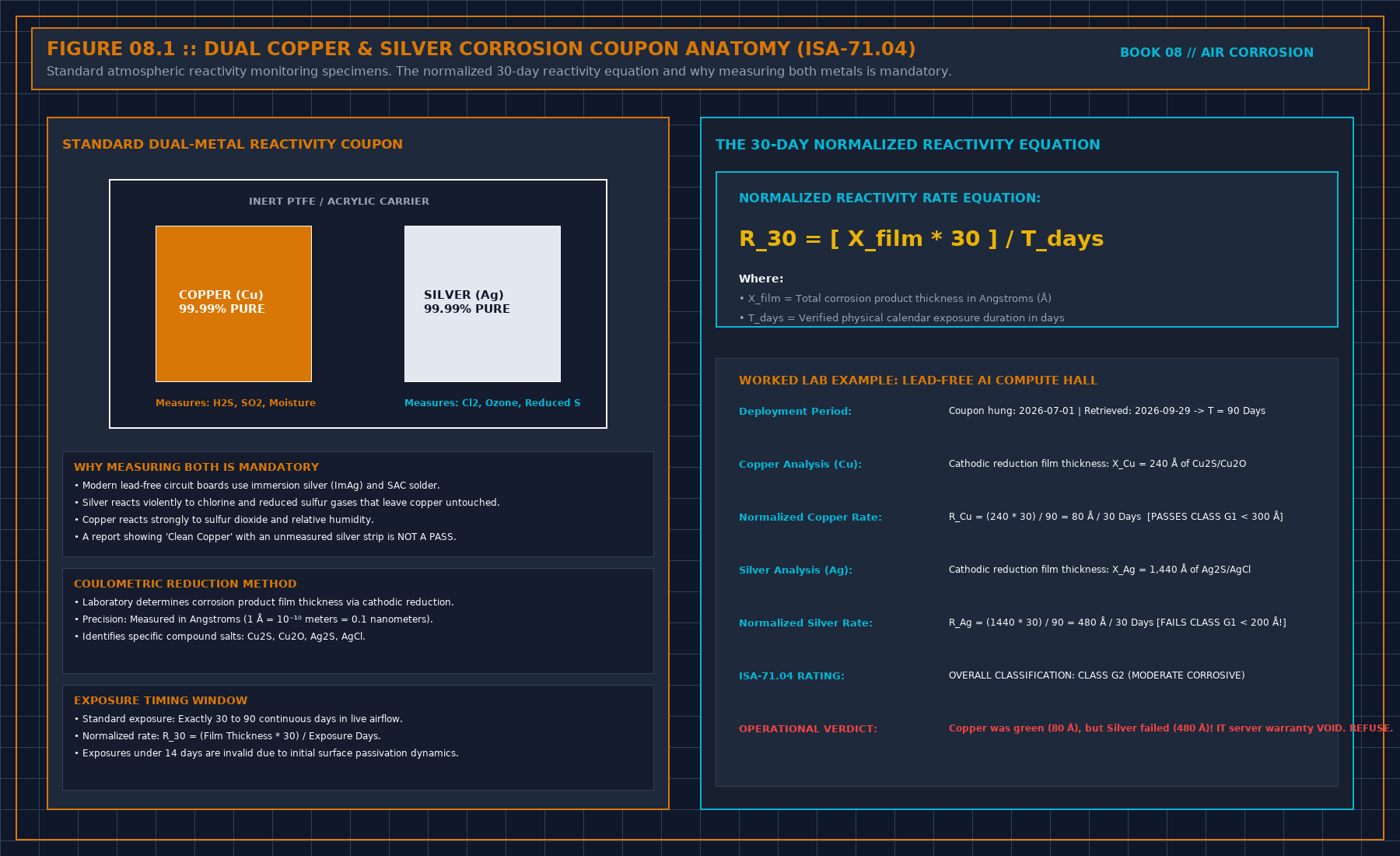
When enterprise and hyperscale IT hardware transitions to lead-free electronics mandated by RoHS (Restriction of Hazardous Substances), data centers face an invisible killer: airborne gaseous reactivity.
Prior to lead-free regulations, tin-lead solders protected copper traces and circuit pads. Today, modern server mainboards use immersion silver (ImAg) or organic solderability preservatives (OSP). In the presence of sub-parts-per-billion concentrations of hydrogen sulfide ($\text{H}_2\text{S}$), sulfur dioxide ($\text{SO}_2$), or chlorine ($\text{Cl}_2$), silver corrodes into silver sulfide ($\text{Ag}_2\text{S}$) crystals.
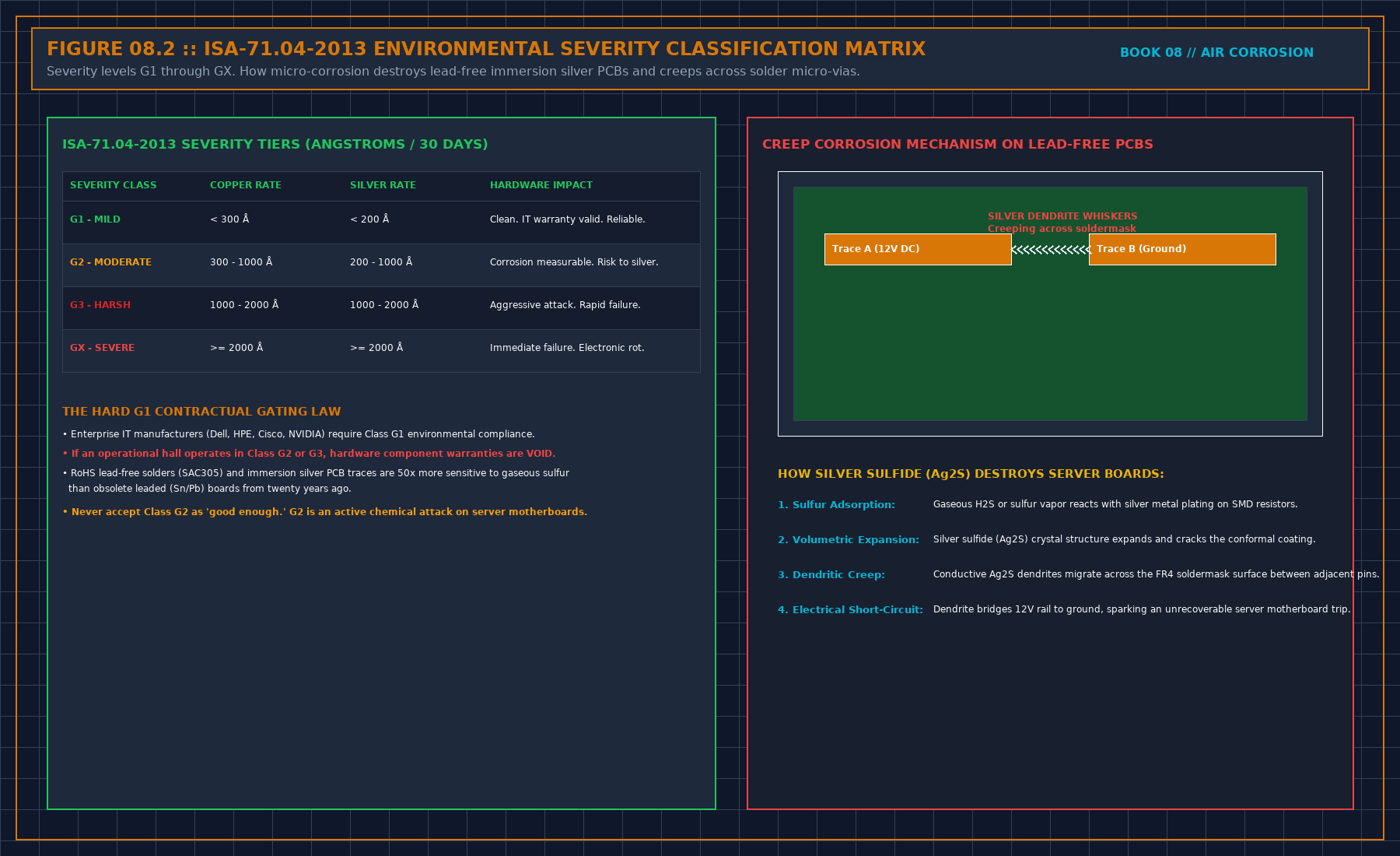
These crystals exhibit rapid "creep corrosion," forming conductive dendrites that bridge micro-vias and 0.5-mm pitch ball grid array (BGA) component pins, causing unrecoverable short circuits in production AI clusters.
1. ANSI/ISA-71.04-2013 Severity Classifications
The industry standard ANSI/ISA-71.04-2013 (Environmental Conditions for Process Measurement and Control Systems: Airborne Contaminants) establishes four severity tiers based on normalized 30-day reactivity rates:
| Severity Level | Copper Reactivity Rate ($R_{\text{Cu}}$) | Silver Reactivity Rate ($R_{\text{Ag}}$) | Operational Impact & Electronics Warranty |
|---|---|---|---|
| Class G1 (Mild) | $< 300\,\text{Å} / 30\,\text{days}$ | $< 200\,\text{Å} / 30\,\text{days}$ | Mandatory Warranty Baseline: RoHS electronics safe from creep corrosion. |
| Class G2 (Moderate) | $300\text{--}1,000\,\text{Å} / 30\,\text{days}$ | $200\text{--}1,000\,\text{Å} / 30\,\text{days}$ | Warning: Elevated risk of silver dendrite shorting; media filtration required. |
| Class G3 (Harsh) | $1,000\text{--}2,000\,\text{Å} / 30\,\text{days}$ | $1,000\text{--}2,000\,\text{Å} / 30\,\text{days}$ | Rejection: Rapid hardware failure within 12–24 months; voided vendor warranties. |
| Class GX (Severe) | $\ge 2,000\,\text{Å} / 30\,\text{days}$ | $\ge 2,000\,\text{Å} / 30\,\text{days}$ | Emergency Hazard: Uncontrolled atmospheric contamination; immediate plant halt. |
The Critical Copper vs. Silver Divergence
A common testing trap is measuring only copper coupons. Copper is sensitive to acidic sulfur gases ($\text{H}_2\text{S}$ with moisture) but relatively insensitive to dry chlorine or low-concentration sulfide atmospheres.
Silver, conversely, corrodes aggressively in dry environments containing trace hydrogen sulfide or ozone. A data hall can show a completely clean copper reading ($<150\,\text{Å}$, seemingly Class G1) while silver film thickness spikes to $1,500\,\text{Å}$ (Class G3 Harsh).
The Warranty Rule:
Both copper and silver must meet Class G1 thresholds simultaneously. If either metal exceeds Class G1, the whitespace is legally classified at the higher severity tier.
2. 30-Day Normalization & Coulometric Reduction
When corrosion coupons are exposed for non-standard durations (e.g., 26 days or 34 days due to logistics), the raw film thickness ($X_{\text{film}}$, measured in Angstroms, where $1\,\text{Å} = 0.1\,\text{nm}$) must be mathematically normalized:
$$R_{30} = \frac{X_{\text{film}} \times 30}{T_{\text{days}}}$$
Where:
- $R_{30}$ is the normalized 30-day corrosion rate ($\text{Å}/30\,\text{days}$).
- $X_{\text{film}}$ is the total corrosion film thickness determined by laboratory coulometric reduction.
- $T_{\text{days}}$ is the exact exposure duration (days, calculated to the hour: $T_{\text{days}} = \Delta t_{\text{hours}} / 24$).
Coulometric Electrolytic Reduction
In the testing laboratory, the exposed metal strip is placed in an electrolytic cell containing an inert deaerated electrolyte (sodium carbonate solution). A constant reduction current ($I_{\text{red}}$) is applied.
As each corrosion product layer ($\text{Cu}_2\text{S}$, $\text{Cu}_2\text{O}$, $\text{Ag}_2\text{S}$) is electrochemically reduced back to base metal, the electrode potential steps through characteristic voltage plateaus:
$$X_{\text{film}} = \frac{M \times I_{\text{red}} \times t_{\text{plateau}}}{z \times F \times A \times \rho}$$
Where $M$ is molar mass, $z$ is valence change, $F$ is Faraday's constant ($96,485\,\text{C/mol}$), $A$ is exposed surface area, and $\rho$ is compound density.
3. The Four Hanging Stations in a Data Hall
Where you hang the coupon determines what sentence you may write:
- Station 1: Fresh Outdoor Makeup Air Intake (Pre-Filter): Measures baseline ambient environmental hostility (exhaust fumes, industrial sulfur, agricultural ammonia).
- Station 2: Chemical Filter Scrubber Discharge (Post-Media): Directly measures chemical filter bank efficiency and verifies whether media has reached breakthrough ($>5\%$ bypass).
- Station 3: Cold Aisle Inflow (1.2m Elevation at Rack Face): The primary compliance measurement representing actual air entering server chassis fan grilles.
- Station 4: Hot Return Air Plenum: Measures thermal acceleration of corrosion (reaction rates double for every $+10^\circ\text{C}$ rise per Arrhenius kinetics).
4. Real-Time Telemetry: Passive Coupons vs. QCM Monitors
While 30-day passive coupons provide the definitive legal record for OEM server warranties, they cannot warn operations teams of an acute pollution event (such as a nearby chemical spill or asphalt resurfacing outside the intake).
To bridge this gap, modern facilities deploy Quartz Crystal Microbalance (QCM) sensors. A QCM sensor applies an alternating electrical field to a gold-plated quartz resonator coated with thin copper or silver films. As corrosion film forms, the added mass decreases the crystal's resonant oscillation frequency per the Sauerbrey equation:
$$\Delta f = - \frac{2 f_0^2}{A \sqrt{\rho_q \mu_q}} \Delta m = - C_f \Delta m$$
Where $f_0$ is fundamental resonant frequency ($5\text{--}10\,\text{MHz}$), $\rho_q$ is quartz density ($2.648\,\text{g/cm}^3$), $\mu_q$ is shear modulus ($2.947 \times 10^{11}\,\text{g/cm}\cdot\text{s}^2$), and $\Delta m$ is accumulated corrosion mass.
A QCM monitor provides minute-by-minute rate of change ($\text{Å}/\text{hour}$), alerting the BMS to close fresh air dampers before chemical media beds are overwhelmed.
Frequently Asked Questions (FAQ)
What causes silver creep corrosion on server motherboards?
Silver creep corrosion occurs when airborne sulfur compounds (primarily hydrogen sulfide $\text{H}_2\text{S}$ and elemental sulfur vapor) react with immersion silver surface finishes on printed circuit boards. The resulting silver sulfide ($\text{Ag}_2\text{S}$) crystals migrate across epoxy solder masks, creating conductive crystalline bridges between closely spaced electrical circuits and causing fatal component shorts.
Can a data center achieve Class G1 without chemical gas scrubbers?
Only if the ambient outdoor air quality is extraordinarily pristine (such as remote arctic or mountain locations). In urban, industrial, coastal, or agricultural regions, particulate MERV 13/14 filters do not capture gaseous pollutants. Specialized deep-bed chemical filtration media—utilizing activated carbon for VOCs and potassium permanganate ($\text{KMnO}_4$) impregnated alumina for acid gases—is mandatory to achieve Class G1.
Why must every corrosion coupon shipment include a Travel Blank?
A Travel Blank is an identical, sealed coupon that accompanies the test coupons during shipping and storage but is never exposed to whitespace air. It is analyzed alongside the test coupons to verify that corrosion films were not formed during transit or laboratory handling. A report without a verified Travel Blank cannot legally substantiate a Class G1 warranty claim.
The Book Bridge
Protecting mission-critical IT hardware from invisible airborne corrosion requires rigorous testing discipline. The complete environmental field guide—including coupon placement maps, chemical media breakthrough testing, positive pressure leakage calculations, and formal laboratory report refusal templates—is published in Judge a Corrosion Coupon by Tristan.
Judge a Corrosion Coupon ($12.99) — Coming Soon on Amazon Kindle & EPUB
Master the Complete Protocol: Judge a Corrosion Coupon
ANSI/ISA-71.04-2013 Reactivity Monitoring, Chemical Filtration Media, and Lead-Free RoHS Protection
Stop relying on contractor spreadsheets and vendor promises. This field guide provides the complete, auditable verification binder—including acceptance thresholds, physical equations, inspection checklists, and signed refusal templates.